Ag
Pb
Zn
au

The Illinois Creek – Waterpump Creek CRD system extends over 8 kilometers, showcasing remarkable geochemical zonation from the proximal gold-copper-silver oxide resource at Illinois Creek (IC) to the high-grade silver-lead-zinc sulfide resource at Waterpump Creek (WPC).
This geological signature mirrors those of renowned North American CRD systems, including the Santa Eulalia and Naica deposits in Mexico, the Taylor-Sunnyside deposit in Arizona, and the Tintic deposit in Utah. Like these prolific systems, our Illinois Creek - Waterpump Creek project demonstrates the potential for continuous mineralization over extensive distances, a key characteristic of major CRD deposits worldwide.
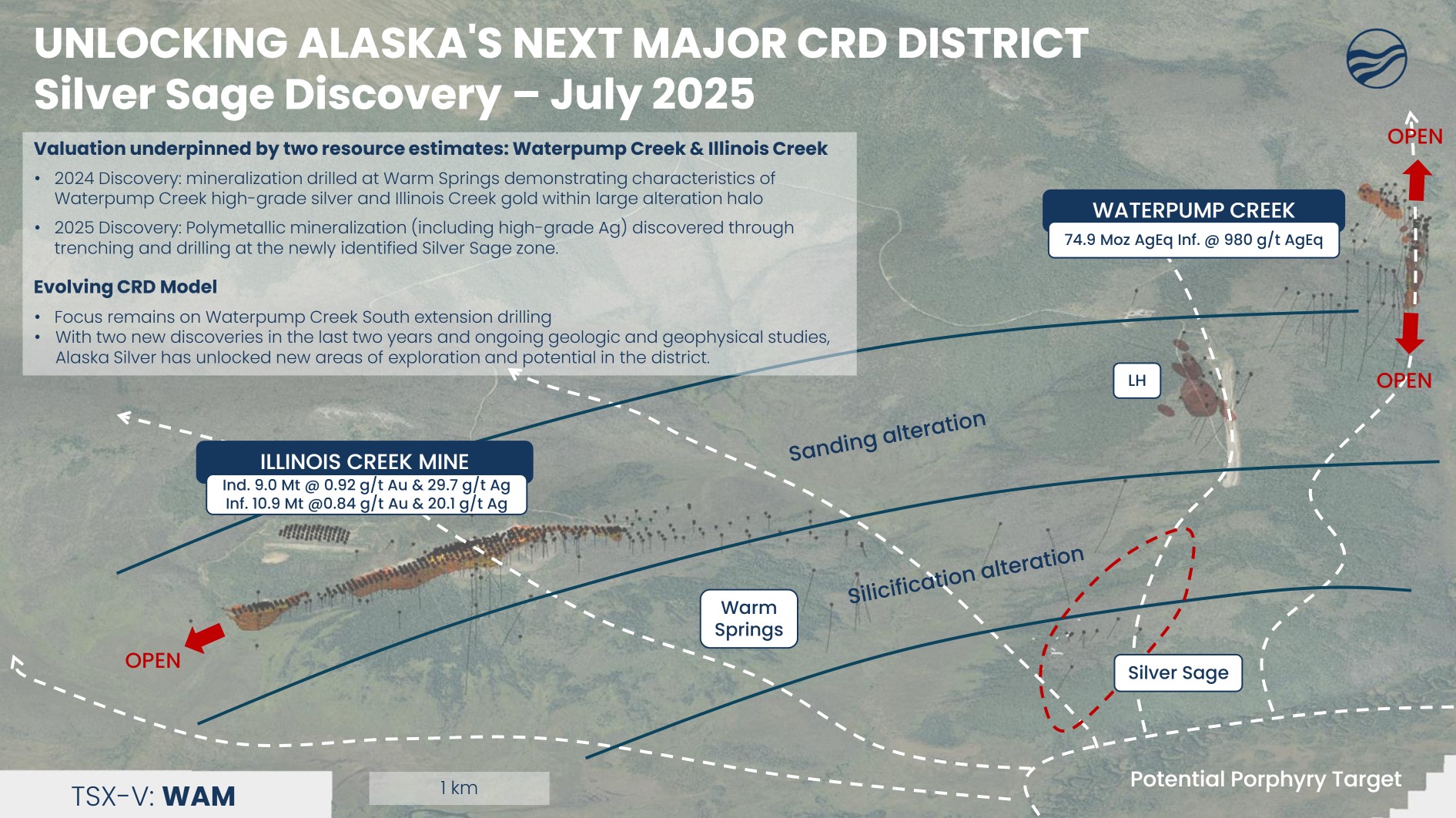
“Waterpump Creek (silver-lead-zinc) is a carbonate replacement style deposit (“CRD”) hosted by the Illinois Creek dolomite sequence. An inferred mineral resource estimate in the sulfide portion (2024) shows 75Moz at 980 g/t AgEq (279 g/t Ag) (See table below). The host dolomite sequence also hosts the main Illinois Creek oxide gold deposit. The WPC CRD target is a distal segment of the greater Illinois Creek hydrothermal system that includes historic Illinois Creek oxide gold deposit. The mineralization is open to the north and to the south (see Waterpump Creek South below).
Recent studies are showing that the high-grade zinc concentration at Waterpump Creek also contains the number one mineral on the U.S. Critical Minerals list, Gallium.
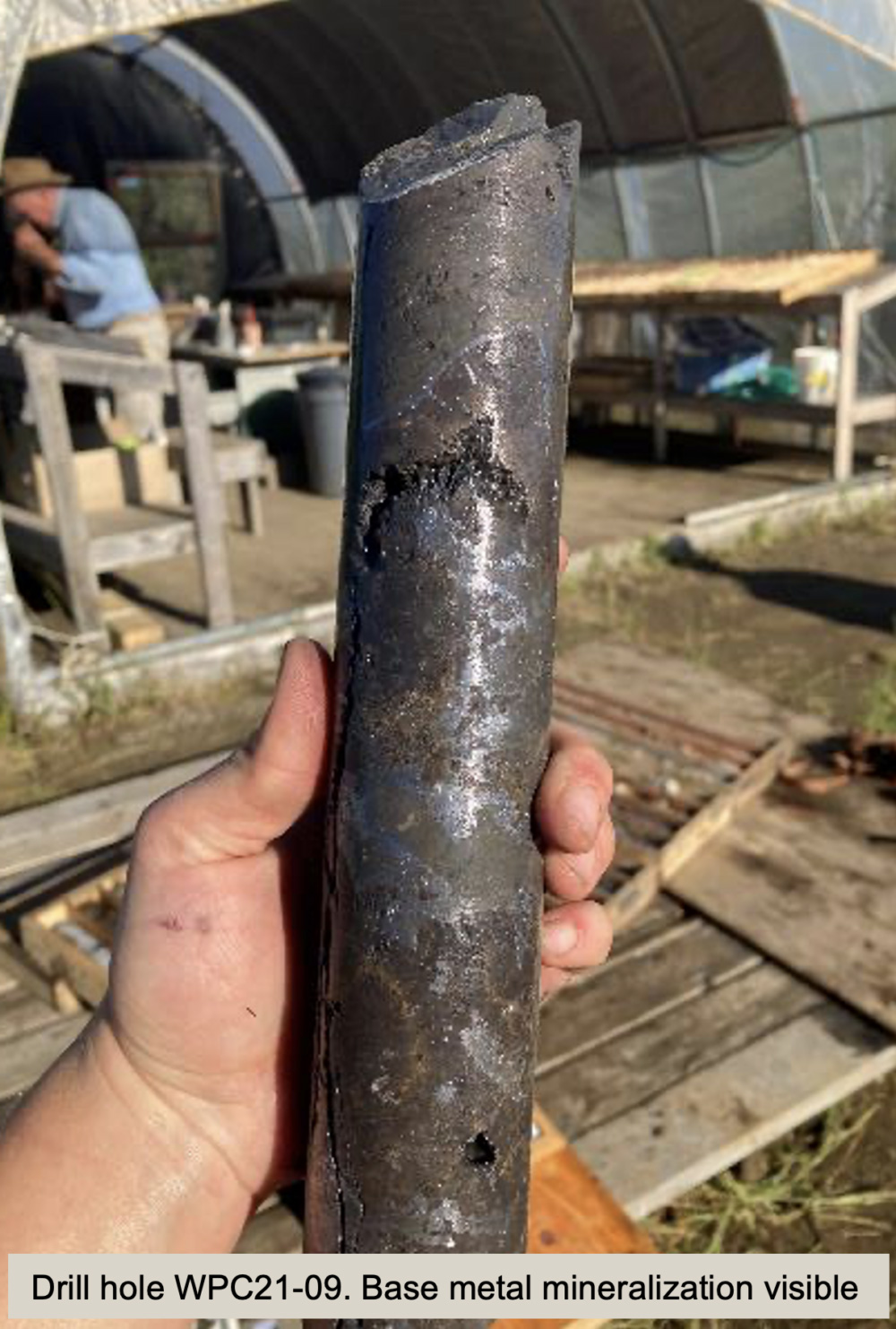
WPC21-09 returned 9.1m TT @ 522 g/t silver, 14.5% lead, 22.5% zinc

Mineral resources are stated based on the following assumptions: Estimated recoveries of 75% Ag, 70% Pb, and 84% Zn, Metal pricing of US$24/oz Ag, US$1.30/lb Zn, and US$ 1.00/lb Pb
The formulas for AgEq and ZnEq based on the above metal prices are AgEq (g/t)= Ag (g/t) + 28.56 x Pb(%) + 37.12 x Zn(%) and ZnEq (%) = Zn (%) + Pb(%) x 0.7692 + Ag (g/t) x 0.0269
The cut-off grade for resources considered amenable to underground extraction methods is 200 g/t AgEq and includes recoveries in the calculations: AgEq(recovery) = Ag (g/t) x 75% + 28.56 x Pb(%) x 70% + 37.12 x Zn(%) x 84%.
Mineral Resources are not Mineral Reserves and do not have demonstrated economic viability. There is no certainty that all or any part of the Mineral Resources will be converted into Mineral Reserves.
Mineral resources in the Inferred category have a lower level of confidence than that applied to Indicated mineral resources, and, although there is sufficient evidence to imply geologic grade and continuity, these characteristics cannot be verified based on the current data. It is reasonably expected that the majority of Inferred mineral resources could be upgraded to Indicated mineral resources with continued exploration.
Between 1982 and 2006 Anaconda Minerals Company and NovaGold Resources drilled 58 diamond drill holes identifying high-grade silver-lead-zinc mineralization. Exploration drilling by WAM is further defining and expanding the CRD mineralization originally discovered by Anaconda.
Nine drill holes were completed by WAM at the Waterpump Creek target in 2021. The drilling focused primarily on delineating shallow oxide silver mineralization previously drilled by Anaconda and NovaGold. The Company also completed two drill holes to test the historically recognized sulfide CRD mineralization at depth. Drill hole WPC21-09 cut 10.5-meters (9.1 meters true thickness) of 522 g/t Ag, 22.5% Zn and 14.4% Pb of massive intergrown sphalerite and argentiferous galena down-dip of the historical drilling. This exceptional high-grade interval turned the focus on exploration, targeting the overall CRD potential on the property.
WAM’s 2022 drill program rapidly expanded and delineated the Waterpump Creek Ag-Pb-Zn CRD mineralization with multiple, thick (like hole WPC22-18 that intersected 101.7m of 160 g/t Ag, 5.3% Pb, and 5.4% Zn), high-grade silver-lead-zinc intercepts. The 2023 infill and step-out drilling intersected additional high-grade silver intervals that demonstrate the continuity of mineralization and provided sufficient drill hole density to allow for the mineral resource estimation.
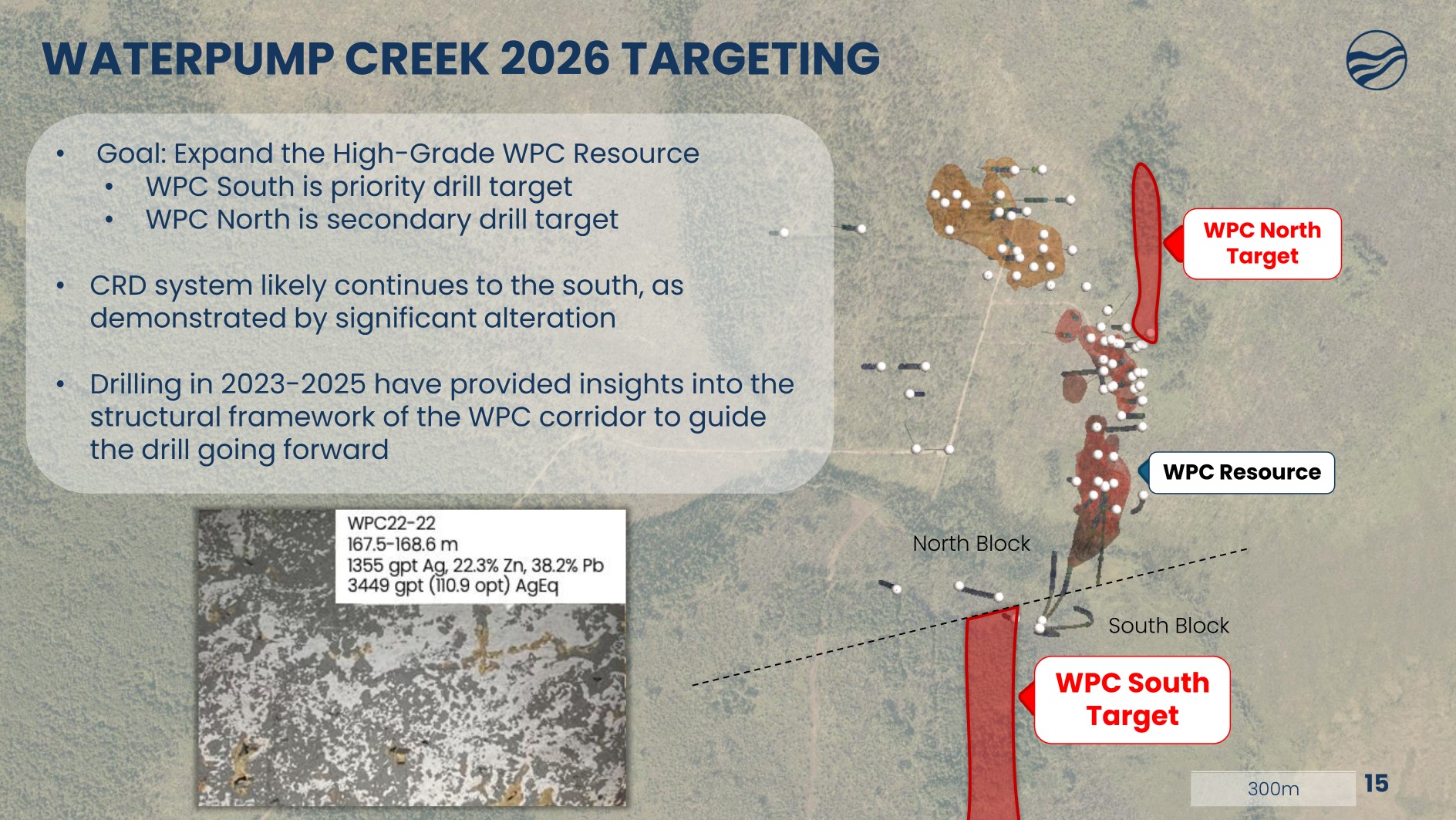
For the 2026 field season, the southward extension of the high-grade Ag-Pb-Zn sulfide WPC deposit will be a high-priority exploration target. The 4700 North Fault truncates the WPC resource on its southern margin, and only limited drilling has tested the down-faulted southern offset. First-pass interpretation of the preliminary 2024 SkyTEM airborne EM survey, together with 2025 drilling results, suggests the 4700 North Fault is a normal fault with a right-lateral strike-slip component. Identifying the southern continuation of the high-grade CRD system has the potential to rapidly expand the resource.
The LH target, discovered in the 1980’s as the Last Hurrah prospect by Anaconda, consists of Pb-Zn +/- Ag soil anomalies coincident where the prospective WPC carbonate and overlying schist contact comes to surface south-southwest of Waterpump Creek. Drilling by NovaGold Resources in 2006 and WAM in 2021, 2023, and 2024 intersected extensive CRD-style alteration and local Pb-Zn-Ag oxide mineralization, indicating that at least one spoke of the IC CRD system runs through LH. The trenching and drilling completed in 2024 indicates that the oxide mineralization is controlled by a vertical structure and the main WPC structure remains untested and lies farther east (see Waterpump Creek South below).
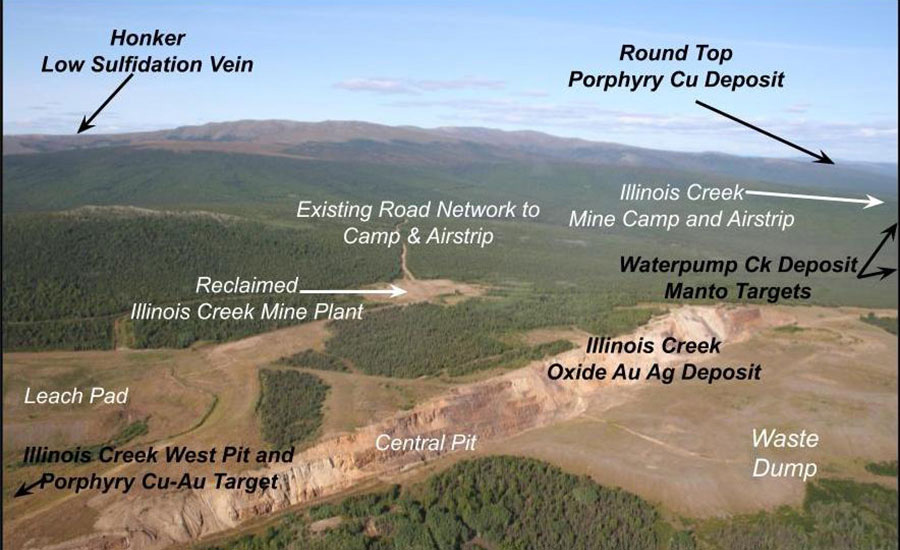
Alaska Silver’ most advanced stage asset is the Illinois Creek oxide gold-silver deposit, a past-producing run of mine (ROM) heap leach mine that operated between 1997 and 2002. The mine shut down was in part due to gold prices falling below US$300 and poor operational recoveries. In 2018, the company entered into a Joint Venture Agreement with Piek Inc. to advance the resource and ultimately purchase the asset and the entire Illinois Creek property. In March 2021, Alaska Silver (then Western Alaska Copper & Gold) completed a cash and stock purchase agreement with Piek Inc. to capture 100% of the Illinois Creek property which also includes the Waterpump Creek CRD target.
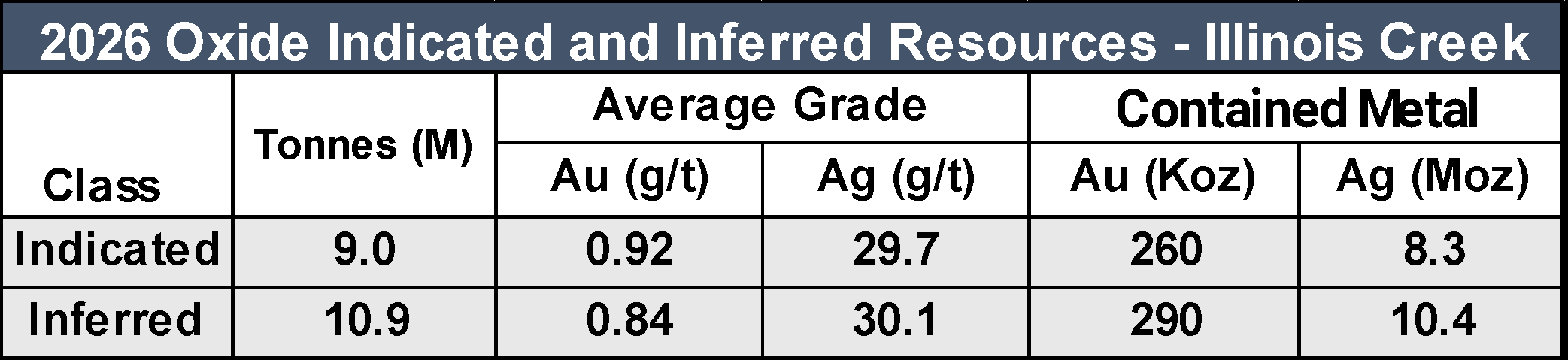
The Illinois Creek Project hosts a robust near-surface oxide resource, completed in January 2026, with significant gold and silver content. Indicated Mineral Resources total 9.0 million tonnes grading 0.92 g/t gold and 29.72 g/t silver, containing approximately 260,000 ounces of gold and 8.3 million ounces of silver. Inferred Mineral Resources add a further 10.9 million tonnes at 0.84 g/t gold and 30.1 g/t silver, containing 290,000 ounces of gold and 10.4 million ounces of silver. The resource is constrained within an open-pit shell using metal prices of US$3,500/oz gold and US$45/oz silver. Mineralization is oxide in nature, amenable to heap leach processing, and remains open along strike and at depth.
Major optimization upsides exist at the historical mine, particularly on the process and recovery side. Merrill Crowe processing could strongly impact silver recoveries and Cu pre-strip or suppression using a SART process could provide a valuable copper concentrate and improve gold recoveries.
The Illinois Creek deposit is an oxidized Au-Cu-Ag CRD consisting of stacked mantos and breccias localized along the ENE-WSW trending Illinois Creek fault (shear zone). The Illinois Creek mineralization is open in both directions along strike, particularly to the west, where there are at least 4 other gossans exposed on surface including the “Macho Grande” and “5 o’clock” gossans. Although oxidized at IC, the mineralization appears very similar to Warm Springs (partially unoxidized) in that there is significant complexity including early stage mantos, later brecciation, and multiple pulses of fluid.
The current resource spans over 2 km along strike, with mineralization remaining open at depth. This presents significant potential for expansion by following up on the known mineralization down-dip, along strike, and deeper within the mineralized structure.
Patrick Donnelly P.Geo, Executive Vice President of Alaska Silver, a Qualified Person under National Instrument 43-101, has reviewed and approved the scientific and technical disclosure on this website. He is a member of the Engineers and Geoscientists of British Columbia.
The gold-silver (Au-Ag) resource is open down dip and along strike.
Major optimization upsides exist at the historical mine, particularly on the process and recovery side. Merrill Crowe processing could strongly impact silver recoveries and Cu pre-strip or suppression using a SART process could provide a valuable copper concentrate and improve gold recoveries.
Patrick Donnelly P.Geo, Executive Vice President of Alaska Silver, is a Qualified Person under National Instrument 43-101, has reviewed and approved the scientific and technical information in this website. Mr. Donnelly is a member of the Engineers and Geoscientists of British Columbia.
Gallium: The Silent Power Behind the Future
Gallium is the unsung hero of modern technology and national security. It is used in LED lighting, semiconductors, artificial intelligence, data centers, 5G networks, satellite communications, smartphones, solar cells, magnets in electric vehicles and wind turbines, and critical technologies that safeguard defense systems. The United States is 100% dependent on imported gallium, with the vast majority sourced from China. When China imposed export restrictions, it highlighted the urgent need for domestic sources of this critical element. Gallium has been ranked as having the greatest US supply risk.
Alaska Silver is proud to be at the forefront of this mission, unlocking America’s potential to produce its own critical minerals and ensuring a future powered by innovation, sustainability, and security. The gallium story at Waterpump Creek has just begun. Drill core from the 2022 and 2023 seasons had been sampled and assayed using ALS ME-ICP61, which is not precise for Ga at the expected concentrations but did return a range of values from below detection limits to well above detection limits. Select high-grade Ga samples have been selected and are being re-analyzed using ALS ME-MS61 method, which will have greater accuracy and precision for Ga. In 2023, five metallurgical composites were produced from WPC drilling that are meant to be representative of the resource and delivered to ALS labs in Kamloops, British Columbia (accreditations ISO 9001, 14001, and 450001, for testing). These composites are from 8 drill holes from the 2022 WPC drill season, over various intervals and depths, consisting of coarse rejects from drill core. These composites show Ga values ranging from 1.66 ppm to 23.7 ppm Ga. The highest Ga composite at 23.7ppm Ga is from of 35.4m core from drill holes WPC22-20 and WPC22-22. As the world races toward a high-tech, energy-efficient future, securing a stable supply of gallium is no longer an option—it’s a necessity.
Zinc: The Foundation of Strength, Innovation, and Sustainability
Zinc (Zn) is a critical element that strengthens industries, protects infrastructure, and supports human health. Zinc’s primary use is for galvanization, which shields steel and iron from corrosion, extending the lifespan of bridges, buildings, and critical infrastructure. Zinc alloys, including brass and bronze, are the backbone of industries from automotive and medical to construction and marine applications. In energy storage, zinc batteries offer a promising solution for the next generation of renewable power systems. Zinc oxides are crucial in rubber production, chemical paints, and agriculture.
Alaska Silver is proud to contribute to securing this essential metal, ensuring a resilient and sustainable future for generations to come. A 43-101 resource estimate was filed on April 2, 2024 with an impressive high grade of 11.28% zinc, containing 591 million pounds (295,500 tons) of zinc at the Waterpump Creek deposit. The zinc is hosted within the mineral sphalerite (zinc sulfide) that is one of the dominant minerals of the WPC massive sulfide zone. Zinc has built civilizations for centuries, and its role in shaping the future is just as vital. From safeguarding infrastructure to advancing clean energy solutions, zinc remains a cornerstone of progress.
Useful Links: